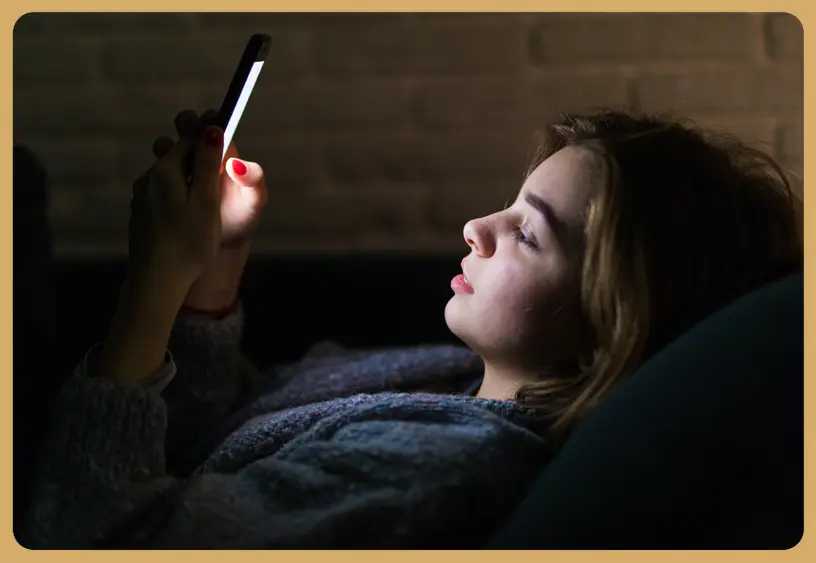
The person asking about this has usually already done the obvious things. Night mode enabled permanently. Amber-tinted glasses bought in November and worn most evenings. A warm bulb in the bedside lamp. Screen brightness dropped so low that reading anything is slightly unpleasant.
Then you ask what time she actually goes to sleep. Phone down at half eleven most nights, in theory. In practice she starts on one thing at ten and surfaces somewhere past midnight without a clear account of the intervening two hours. Sixteen minutes on a news story about something happening four thousand miles away. A comment section. Then a different comment section. Lights off at half twelve, awake and alert, replaying an argument she read between strangers. And the question she arrives with is always some version of the same one. I removed all the blue light, so why has nothing changed?
This blog is for people who have optimised the light and are still lying awake. The blue light story is real but small, and it has been doing a very effective job of hiding the thing that actually costs you the sleep.
What blue light actually does
The mechanism is genuine, so start there rather than dismissing it.
Specialised cells in the retina carry a pigment called melanopsin, and they are most responsive to short-wavelength light in the blue range. When those cells fire, they signal the master clock in the brain, which in turn suppresses melatonin release from the pineal gland. Melatonin is the signal that evening has arrived, so suppressing it in the evening delays the whole system.
None of that is marketing. It is well-established physiology, and light at night genuinely can push your body clock later.
The question was never whether the effect exists. It is how big it is when the light source is a phone at arm's length rather than a laboratory light box.
Why the effect is smaller than you were told
Here is where the popular version comes apart, and the numbers are worth knowing.
In the landmark study people cite for this, participants read from an eReader at full brightness for four hours before bed. That produced a delay in sleep of roughly ten minutes. Four hours of maximum-brightness screen exposure for a ten minute cost.
Blue-blocking glasses have fared no better under scrutiny. A 2023 Cochrane review covering seventeen randomised trials found no clear benefit for visual fatigue and inconsistent, largely unconvincing effects on sleep.
More recently a study of over a thousand Canadian adults found overall sleep health was broadly similar between people who used screens at bedtime every single night and people who used none at all. The researchers noted that earlier work had often failed to account for timing, intensity and age, and that some experimental setups were built in ways that made the blue light look guiltier than it is.
The physiology is real. The everyday consequence has been substantially oversold.
What is actually keeping you awake
Your phone is not keeping you up because it glows. It is keeping you up because it is interesting.
Sleep requires a descending level of arousal. What you do on the device runs directly against that. All of these raise alertness, and no filter on the screen touches that:
- An argument in a comment section.
- A work email you should not have opened.
- A genuinely distressing news story.
- A video engineered by a recommendation system to make stopping feel unnatural.
This is why the tense email keeps you awake whether the display is blue, amber or black and white.
Why doomscrolling in particular
The word is used loosely, so it is worth being specific about what it does.
Doomscrolling means consuming a continuous stream of distressing information, usually about things you cannot influence, usually late, usually longer than intended. It activates the threat response. Cortisol and adrenaline rise, which is precisely the opposite of the physiological state sleep requires.
It also gives your mind material. You put the phone down and the brain, now in bed with nothing to occupy it, returns to whatever it was just fed. The scrolling ends. The arousal does not.
Feeds are also built to prevent a natural stopping point, which is not accidental. Infinite scroll exists specifically so there is never a moment where the content ends and you notice the time.
The part nobody explains
Now the largest effect of all, and the one nobody bothers to name because it is unglamorous.
The main way phones damage sleep is that they eat the hours. Not through melatonin, not through arousal, simply through time. You meant to sleep at eleven and you slept at half twelve, so you lost ninety minutes of sleep to a mechanism no filter can address.
Sleep researchers call the related behaviour bedtime procrastination, and it describes something most people recognise. Delaying sleep without any external reason to be awake, usually because the day contained nothing that belonged to you and the late evening is the only unclaimed time available.
That last part matters, because it means the phone is often a symptom. Someone with no autonomy over their working day reclaims it at midnight, from the only hours nobody else has a claim on.
What actually helps
- Set a stopping point rather than a stopping intention, because the feed will not supply one. An alarm, a charger in another room, a rule that the device does not enter the bedroom.
- Change what you consume before you change the colour temperature. Passive and dull beats interactive and stimulating. Reading something on paper works partly because a book has pages that end and no notifications.
- Keep night mode and dim your screen anyway. Both are free and harmless. Treat them as a small adjustment rather than a solution, which is roughly what the evidence supports.
- Look honestly at the day rather than the device if you keep pushing your bedtime later despite wanting to sleep. Bedtime procrastination usually resolves when someone gets some genuine time back earlier in the day.
If sleep is still poor after all of that, particularly if you are waking in the small hours or exhausted despite adequate hours, the phone is probably not the cause and something else deserves a look.
Conclusion
Blue light became the story because it was simple, measurable, and something could be sold against it. It was never the main event.
What costs you sleep is that the device is stimulating, endlessly supplied, and quietly consuming the hours you meant to spend asleep. A filter cannot fix any of those three.
Stop optimising the colour of the light and look at what it is showing you. Book a consultation with Zivanza Wellness if your sleep is not improving whatever you try. Book Now
- Share