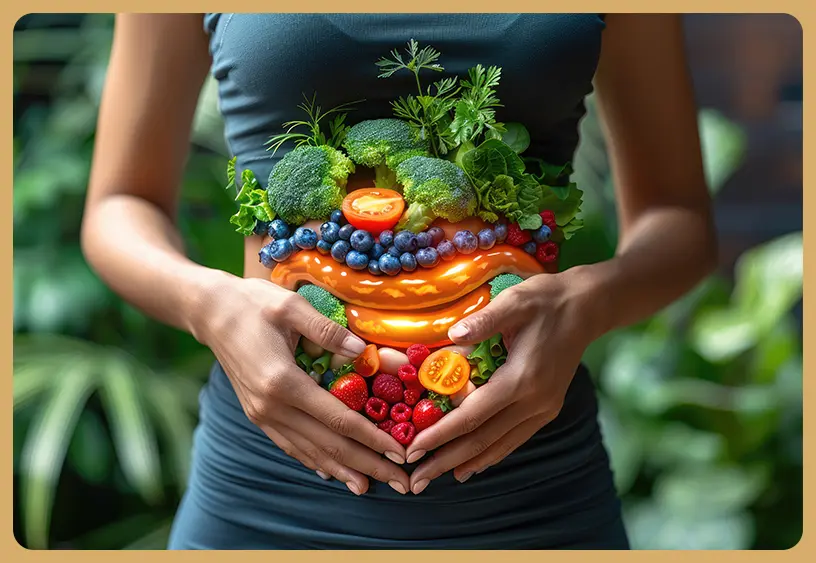
The person who comes in low and anxious has usually already tried the gut. She's read that ninety percent of serotonin is made down there, that the gut is the second brain, that mood starts in the intestine. So when she found that out, the relief was immediate. This wasn't going to need medication or years of therapy. This was going to be a capsule.
Then a year passes and the numbers don't add up the way she expected:
- Three probiotic bottles in the cupboard, two abandoned.
- A kombucha habit.
- A postal microbiome test that told her she was low in diversity without telling her what to do about it.
- Several hundred dirhams a month, faithfully.
And the question on her face is always the same. Is any of this real, or have I been buying yoghurt with a marketing budget?
This blog is for people who suspect the gut-brain link is more than a wellness trend but can't tell where the science stops and the supplement industry starts. The biology is more interesting than the hype, and once you see how it works, the things sold to you look a lot less impressive than the things that aren't.
What the Serotonin Statistic Actually Means
The number is misleading and always has been. It's true that around ninety to ninety-five percent of the body's serotonin is produced in the gastrointestinal tract, mostly by specialised cells in the intestinal lining. What almost never survives the trip to the podcast version is the next line. That serotonin does not cross the blood-brain barrier.
Gut serotonin works locally. It drives motility, coordinates digestive reflexes, and stimulates the vagus nerve. The brain makes its own, separately, and no amount of intestinal serotonin gets couriered upstairs to improve your Tuesday.
The real connection is less magical and more useful:
- Your bacteria ferment fibre into short-chain fatty acids like butyrate, which feed the cells lining your colon and help keep the barrier intact.
- They shape how much tryptophan, serotonin's raw material, is available in the first place.
- They influence inflammatory signalling throughout the body, and inflammation has well-documented effects on mood, motivation and fatigue.
- Meanwhile the vagus nerve carries a constant stream of information upward.
Swallow a probiotic capsule into this system and something does happen. The strains survive the journey and show up in your stool. That sounds like a win. It usually isn't the win it looks like.
Why the Probiotic Aisle Doesn't Tell You What You Think It Does
A group of Israeli researchers did something almost nobody does. Instead of measuring stool, they used endoscopy to see what was actually living on the gut wall while participants took an eleven-strain probiotic. The strains were alive and viable. But whether they colonised anything was person-specific, region-specific and strain-specific, and some people's resident bacteria simply refused them entry. Crucially, finding the strains in stool told you nothing about whether they had settled anywhere. The capsule was passing through.
The same group then tested probiotics after a course of antibiotics, the situation in which they're most often recommended. Compared with simply waiting, the probiotic group's own native microbiome took markedly longer to return, and returned less completely.
None of this makes probiotics worthless. Specific strains have real evidence for specific problems. It does mean a generic capsule bought on the strength of a podcast isn't doing what the label implies.
Eleven strains in a capsule against a hundred trillion residents isn't a renovation. It's a house guest.
The Thing That Quietly Drives Every Recommendation We Make
Inflammation. It's the most plausible route by which what happens in your gut reaches your head, and it's the thing that moves when the diet moves.
In a Stanford trial, thirty-six healthy adults spent ten weeks on either a high-fermented-food diet or a high-fibre one. The fermented-food group showed increased microbial diversity, with larger servings producing larger effects, and nineteen inflammatory proteins in their blood fell, interleukin-6 among them.
The mental health end of this has been tested directly. In a randomised trial of adults with moderate to severe depression, a twelve-week dietary intervention delivered alongside their usual treatment produced remission in about a third of participants, against eight percent in the control group.
When patients ask why we're discussing lentils when they came here about their mood, this is the answer. The microbiome doesn't need to be seeded. It needs to be fed.
Where the Choices Actually Change the Outcome
This is the part that gets buried under product marketing. There's no recipe, just a few decisions that carry most of the weight.
- Plant variety is the big one. The American Gut Project found that people eating more than thirty different plant types a week had markedly more diverse gut microbiomes than those eating ten or fewer, and this held regardless of whether they called themselves vegetarian, omnivore or anything else. Different bacteria eat different fibres. Variety, not volume, is what widens the community.
- Fermented foods do something fibre alone doesn't, at least not quickly. In that same trial, the high-fibre arm increased the fibre-digesting enzymes its bacteria produced, but diversity stayed flat across ten weeks. Fibre changes what your bacteria can do. Fermented food appears to change who's there. You want both.
- What you remove matters too. Ultra-processed food displaces the fibre that would otherwise feed the colony, and the convenience-heavy way most of us eat in this city makes that easy to do without noticing.
Why We Usually Ask You to Start with the Plate, Not the Pill
If we suggest putting the supplement budget into groceries, this isn't old-fashioned. It's what the evidence supports.
Food delivers the substrate, the live organisms and the polyphenols together, which is the combination the research actually tested. There's a practical reason too. Going from fifteen grams of fibre a day to forty-five in a week produces bloating and discomfort reliably enough that most people conclude fibre disagrees with them and stop. Add roughly five grams a week with more water, and you reach the same place without the fortnight that makes you quit.
What a Realistic Gut Week Actually Looks Like
- Oats with berries, chia and a few walnuts is four plants before you've left the house.
- Lentil soup with onion, garlic, carrot and cumin is five more, because herbs and spices count.
- Salad with chickpeas, tahini and parsley.
- Laban or labneh with dinner.
- A handful of pickles.
- Fruit you didn't plan.
By Thursday you're somewhere near twenty-five plants and thirty grams of fibre, and you haven't bought a single thing labelled gut-friendly.
That is a good week. It won't feel like a protocol, but by what the research actually measures, an ordinary varied diet you keep for a year beats an elaborate one you keep for three.
The eight to twelve weeks after you change something is where the effect becomes visible, not the first fortnight. Composition starts shifting within days, but stability takes months, and after antibiotics the recovery runs closer to six months with some species not returning at all. Judge it on sleep, energy and mood rather than a postal test kit, since consumer microbiome reports are better at generating anxiety than instructions. And if you take medication for a mental health condition, treat all of this as something added alongside it, never a replacement.
Conclusion
Your gut doesn't make your mood. It shapes the conditions your mood runs in, through inflammation, through the barrier, through a nerve that never stops reporting. The system does more, not less, than the serotonin soundbite suggests, and the work is in feeding it rather than dosing it. Plant variety, fermented foods and the decision to build slowly instead of buying fast aren't minor details. They separate a change that holds from a cupboard of half-finished bottles.
Stop buying a new capsule every time a podcast mentions one. Book a consultation at Zivanza Wellness and get advice built around your actual diet, your actual symptoms and your actual treatment. Book Now
- Share